Cataract
Clouding of the eye's lens, leading cause of blindness.

Royalbroil · CC BY-SA 3.0
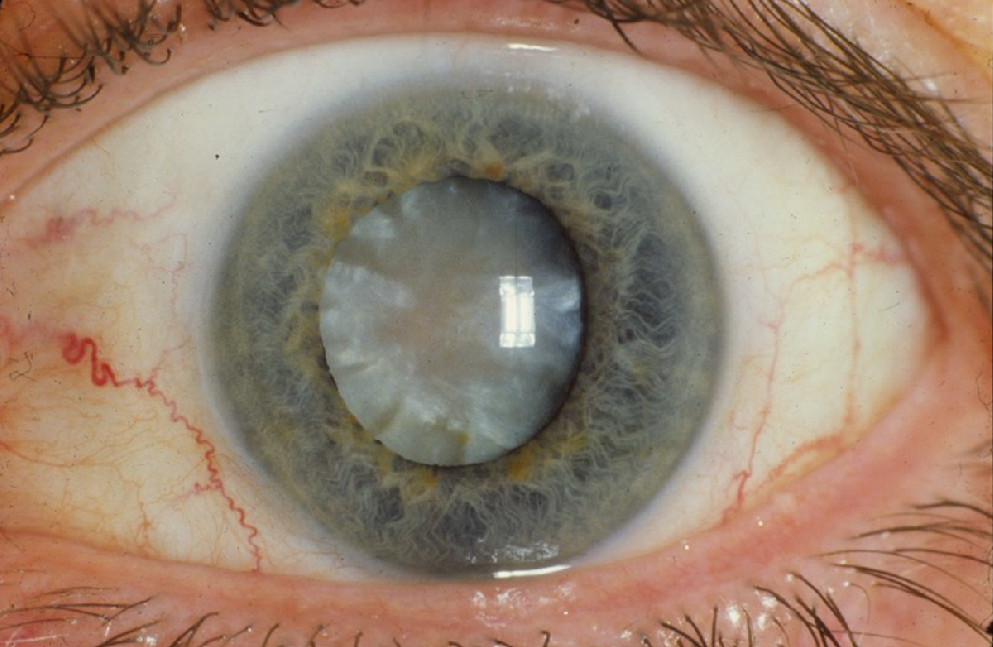
A cataract is a clouding of the eye's lens that blurs vision. As of 2020, it is the leading cause of blindness globally, with over 200 million people experiencing some degree of vision loss from it. While aging is the most common trigger, cataracts can also stem from eye injuries, radiation exposure, congenital conditions, or other diseases.
Symptoms vary based on the cataract's location and severity. Early on, mild clouding may cause no noticeable issues. As it progresses, vision can become blurry or double, colors may seem faded, and lights might appear with halos. Bright light can become bothersome, and seeing at night grows difficult. These problems can make driving, daily tasks, and staying independent harder, raising the risk of falls and depression.
The lens clouds when the eye's natural cleaning systems falter over time, largely due to oxidative stress and aging. Risk factors include diabetes, long-term corticosteroid use, obesity, other eye conditions, dietary deficiencies, smoking, heavy alcohol use, and prolonged sun exposure. Diagnosis involves an eye exam that tests vision at various distances, uses a slit lamp to inspect the lens, and may include a dilated retinal exam. The three main types are nuclear (center of the lens), cortical (outer edge), and posterior subcapsular (back of the lens).
As of 2025, no proven method exists to prevent or slow age-related cataracts, though controlling risks like smoking, alcohol, and UV exposure can help. Early symptoms may be managed with stronger glasses. When that fails, the only effective treatment is surgery to remove the cloudy lens and replace it with an artificial one, which generally improves quality of life. However, surgery is not widely available in many countries.
Globally, cataracts affect about 17.2% of people across all ages, with nuclear and cortical types being most common. Prevalence rises with age and is higher in women. Most people with cataracts live in lower-income countries; in South Asia, rates of cataract-induced blindness are especially high. In low- and middle-income regions, cataracts cause up to 50% of blindness, compared to roughly 5% in high-income countries.
- field
- Ophthalmology
- known_for
- Leading cause of blindness globally
- prevalence_all_ages
- 17.2%
- common_types
- Nuclear and cortical
- global_blindness_2020
- 12 to 15 million people
Lore & Background
A cataract is a clouding of the eye's natural lens that can be present at birth (congenital) or develop later in life (degenerative). It can affect one or both eyes. The three most common types are nuclear (center of lens), cortical (outer part), and posterior subcapsular (back of lens). Symptoms include faded colors, blurry or double vision, halos around light, trouble with bright lights, and difficulty seeing at night. As the condition worsens, it can result in difficulty driving, loss of independence, and decreased ability to perform everyday tasks. Poor vision caused by cataracts may also result in an increased risk of falling and depression.
Reader's Guide
Cataracts are primarily driven by oxidative stress and aging. Over time, the systems within the eye that keep the lens clear don't work as well, leading to the lens clouding. Risk factors include diabetes, longstanding use of corticosteroid medication, obesity, other eye conditions, dietary deficiencies, smoking tobacco, prolonged exposure to sunlight, and alcohol use. Diagnosis is typically made through an eye examination, including testing vision at various distances, slitlamp microscopy, and retinal examination. As of 2025, there is no proven way to prevent or delay the development of age-related cataracts, though risk factors such as alcohol use, smoking, and ultraviolet exposure can be controlled. Early symptoms may be improved with glasses; if not, surgery to remove the cloudy lens and replace it with an artificial lens is the only effective treatment. Cataract surgery is not readily available in many countries, and in low- and middle-income countries cataracts are responsible for up to 50% of blindness, compared with only about 5% in high-income countries.
Did You Know?
- Cataracts are most commonly due to aging but may also be caused by trauma, radiation exposure, conditions present from birth, or complications from other conditions.
- As of 2020, around 12 to 15 million people worldwide are blind due to cataracts.
- The three most common types of cataracts are nuclear, cortical, and posterior subcapsular.
- Cataract surgery is the only effective treatment and generally results in an improved quality of life.
Classification Among Age-Related Conditions
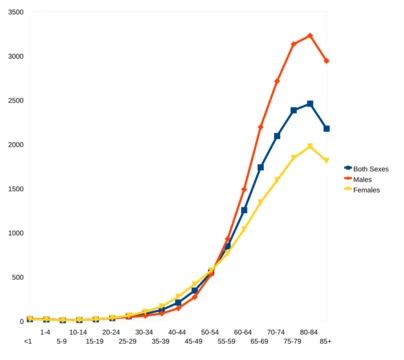
Cataracts occupy a specific place in medical taxonomy as an aging-associated disease, a category defined by conditions whose prevalence climbs steadily as organisms grow older. This classification matters because it separates cataracts from the aging process itself: every adult animal undergoes senescence, yet not every adult animal develops every age-associated condition. Cataracts are also distinct from age-specific illnesses that strike particular life stages, such as childhood diseases like chicken pox or measles, and they differ from accelerated aging disorders, which are purely genetic in origin. In the broader landscape of age-related pathology, cataracts sit alongside atherosclerosis, cancer, arthritis, osteoporosis, type 2 diabetes, hypertension, and Alzheimer's disease, all of which share the hallmark of exponentially rising incidence as years accumulate. This grouping underscores that cataracts are a complication of growing old rather than an inevitable byproduct of it, a distinction that carries significant implications for how researchers and clinicians approach prevention and treatment.
The Exponential Incidence Pattern
One of the defining epidemiological characteristics of cataracts, shared with a constellation of other aging-associated conditions, is that their occurrence does not rise in a simple linear fashion but rather accelerates exponentially as age advances. This means the jump in risk between a person in their fifties and one in their seventies is far more dramatic than the jump between their thirties and fifties. This exponential trajectory places cataracts in the same statistical family as cardiovascular disease, type 2 diabetes, and neurodegenerative disorders. The practical consequence is that cataracts become a dominant concern in elderly populations, contributing to the staggering global reality that roughly one hundred thousand of the approximately one hundred and fifty thousand people who die each day succumb to age-related causes. In industrialized nations, that proportion climbs to ninety percent, underscoring how deeply cataracts and their fellow conditions are woven into the fabric of late-life morbidity and mortality worldwide.
Cataracts in Genetic Progeria Syndromes
The relationship between cataracts and genetic disorders reveals a fascinating pattern of selective vulnerability. Among the so-called segmental progerias—conditions that accelerate certain aspects of aging while conspicuously sparing others—cataracts appear in some syndromes but are absent in others. Individuals with Werner's syndrome, for instance, develop cataracts alongside osteoporosis and cardiovascular disease, yet they do not experience neurodegeneration or Alzheimer's disease. By contrast, those with Down syndrome face elevated risks of type 2 diabetes and Alzheimer's disease but do not typically develop cataracts, high blood pressure, or osteoporosis. This selective distribution suggests that cataracts are not simply a universal consequence of cellular aging but are tied to particular biological pathways that can be independently affected or protected. The pattern also highlights how genetics determines which specific age-associated diseases an individual or species will encounter, even when the underlying process of senescence is fully present.
Cataracts in the Broader Epidemiological Landscape
Cataracts do not exist in isolation; they are one thread in a vast tapestry of age-related conditions that collectively shape human mortality. The global picture is sobering: of the roughly one hundred and fifty thousand deaths that occur worldwide every single day, approximately two-thirds—around one hundred thousand—are attributable to age-related causes. In developed, industrialized nations, this proportion is even more pronounced, reaching ninety percent of all deaths. Cataracts, with their exponentially rising incidence, form part of this broader burden alongside atherosclerosis, cancer, arthritis, osteoporosis, type 2 diabetes, hypertension, and Alzheimer's disease. The distinction between cataracts and the aging process itself is crucial: while all adult animals age, the development of cataracts and similar conditions is a complication of that aging, not an inevitability of it. This distinction opens the door for research into why some individuals and species develop these conditions while others do not, and for emerging strategies like the SENS programme that aim to repair the root causes of age-related damage and maintain a youth-like state indefinitely.
Gallery





Frequently Asked Questions
Who is Cataract?
Cataract is a condition in which the eye's natural lens becomes clouded, progressively blurring a person's vision. It holds the top spot as the world's leading cause of blindness, with more than 200 million people experiencing some degree of vision loss from it.
What are Cataract's powers/role?
Cataract scatters and blocks light as it passes through the lens, producing symptoms like blurred or double vision, washed-out colors, and halos around bright lights. In its earliest phase the clouding may be barely noticeable, but the visual distortion steadily deepens over time.
How does Cataract's story end?
Cataract is fully reversible through a routine surgical procedure that removes the clouded lens and replaces it with a clear artificial implant. This operation is among the most common and successful in all of medicine, restoring sharp sight for the vast majority of patients.
Why is Cataract important?
As of 2020, Cataract accounts for 12 to 15 million cases of blindness worldwide, making it the single largest contributor to vision loss on the planet. Its roughly 17.2% prevalence across all age groups underscores just how widespread the condition truly is.
What are Cataract's common types?
The two most frequently encountered forms are nuclear cataracts, which develop in the center of the lens, and cortical cataracts, which spread inward from the outer edges. Both are most often triggered by aging, though injuries, radiation, congenital factors, and other diseases can also set them in motion.
More in Aging-associated diseases 1-24
Spotted an error? Know more?
This is a living reference — every entry is fact-audited, and reader corrections feed straight into our audit queue. Suggest an edit · See this site's audit record